

“Mythology” Series:
Format: Each week we present a concise mythological story and draw direct parallels to contemporary AI concepts.
Goal: Highlight how modern technological dilemmas mirror ancient Greek tales, sparking interest about both subjects.
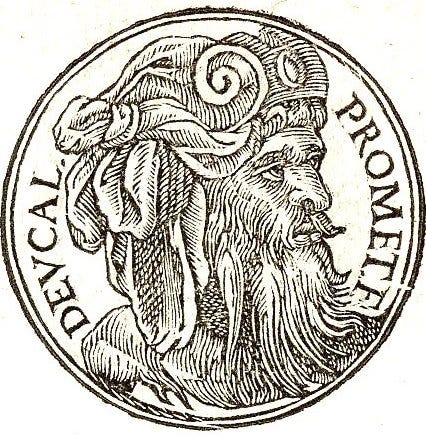
1. Mythological reference
In Greek tradition, Deucalion and Pyrrha survive a cataclysmic flood sent to cleanse a corrupted world. Guided by an oracle, they repopulate the earth by casting stones over their shoulders—which transform into new people. It’s a story of loss, humility, and rebuilding: when everything washes away, wisdom lies in starting with simple, sturdy building blocks.
2. Parallel with AI and lesson from ancient mythology
Rebuilding after the deluge: disaster recovery for AI
Modern AI platforms can face their own “floods”: cloud region outages, ransomware, model or data poisoning, supply-chain compromises, or catastrophic data loss. The Deucalion–Pyrrha myth maps cleanly onto disaster recovery (DR) and resilience:
Name the deluge
Distinguish between availability events (region failures), integrity events (corruption, poisoning), and confidentiality events (breaches). Each demands a different RTO/RPO and playbook.Cast the stones (minimum seeds)
After a failure, you don’t resurrect everything at once. You start with the essential “stones”:
immutable backups, checksummed datasets, model snapshots with training seeds, infrastructure-as-code, schema contracts, runbooks, and keys/attestations (e.g., SLSA, SBOMs). From these, systems can re-form reliably.Layered safeguards
Use 3-2-1 backups, air-gapped copies, multi-region replication, confidential computing, and zero-trust access. For integrity, keep write-once (WORM) archives of critical labels, eval suites, and safety guardrails.Practice the crossing
Regular chaos engineering, game days, and tabletop exercises ensure teams can execute restores, rotate credentials, and re-verify model lineage under pressure.Ethical restoration
Restoration isn’t just technical. Rebuilding must protect privacy, consent, and fairness. Don’t retrain on breached or illicitly obtained data. If minority data were lost, address representation gaps before relaunch. Publish a clear postmortem and user communications.Trust, but verify
Before reopening floodgates, require cryptographic provenance for data and attested pipelines for models; rerun bias, safety, and robustness evaluations; enable canary releases with kill-switches and human-in-the-loop escalation.
Lesson: start small, prove integrity, then grow
Deucalion and Pyrrha don’t rebuild humanity in one gesture; they seed it with stones. Likewise, resilient AI rebuilds from verified primitives, restores core services first, and scales only as safety, quality, and governance are re-established. Catastrophe becomes a catalyst for cleaner architectures, stricter provenance, and clearer accountability.
3. Reflections and questions to consider
What are our stones?
Which backups, snapshots, docs, and attestations form the minimal, verified seeds of recovery?RTO/RPO reality check
Are our declared recovery objectives actually test-proven across region, tenant, and data-class boundaries?Ethical triage
How will we handle user consent, data deletion requests, and equity impacts during restore and retraining?
4. References
Iliad
Epic scenes of ruin and renewal—context for resilience and the costs of unpreparedness.Odyssey
A masterclass in return, cunning, and phased recovery after catastrophe.Adrienne Mayor, Gods and Robots: Myths, Machines, and Ancient Dreams of Technology
Mythic insights applied to engineered systems—useful for framing ethical rebuilds.Greek and Roman Technology: A Sourcebook (Sherwood, Nikolic, Humphrey, Oleson)
Ancient infrastructure and recovery practices—analogies for modern DR design.NIST SP 800-34 / NIST AI RMF / ISO 22301
Standards for business continuity, risk management, and incident response in AI-enabled systems.Cynthia Rudin et al.; Model Cards / Datasheets for Datasets
Transparency artifacts that speed safe restoration and re-validation.