


Introduction
Welcome back to Laboratory. This week we unpack HBR’s “Designing a Successful Agentic AI System” by Linda Mantia, Surojit Chatterjee, and Vivian S. Lee (Oct 24, 2025). The piece reframes enterprise AI from tools to teammates - coordinated agentic AI that plans, reasons, and acts across functions - anchored by mission owners, shared business logic, and explicit guardrails so outcomes improve rather than just ticket counts.
In this briefing, we chart:
Operating Model Shift: how missions, not departments, become the unit of work and why outcomes beat tasks.
Data Without a Lake: how to unlock APIs, semantics, and decision rules without forcing a single source of truth.
Guardrails to Scale: the governance, auditability, and tiered autonomy that let systems act safely and learn fast.
Executive Summary
Agentic AI replaces fragmented task automation with goal-directed systems that plan, reason, and act across departments. Success depends less on model choice and more on operating model design: appoint mission owners, codify business logic, expose APIs to unlock silos, and embed governance with auditable trails and human oversight. Case evidence from complex environments shows large gains when teams organize around outcomes rather than tickets.
1) What Agentic AI Is
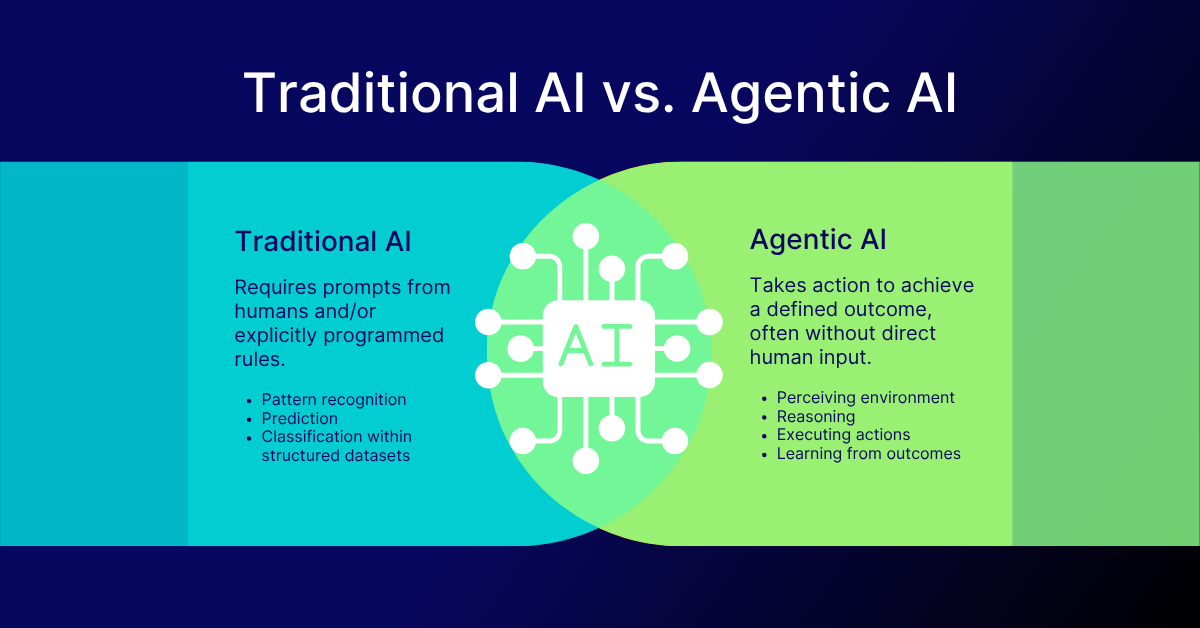
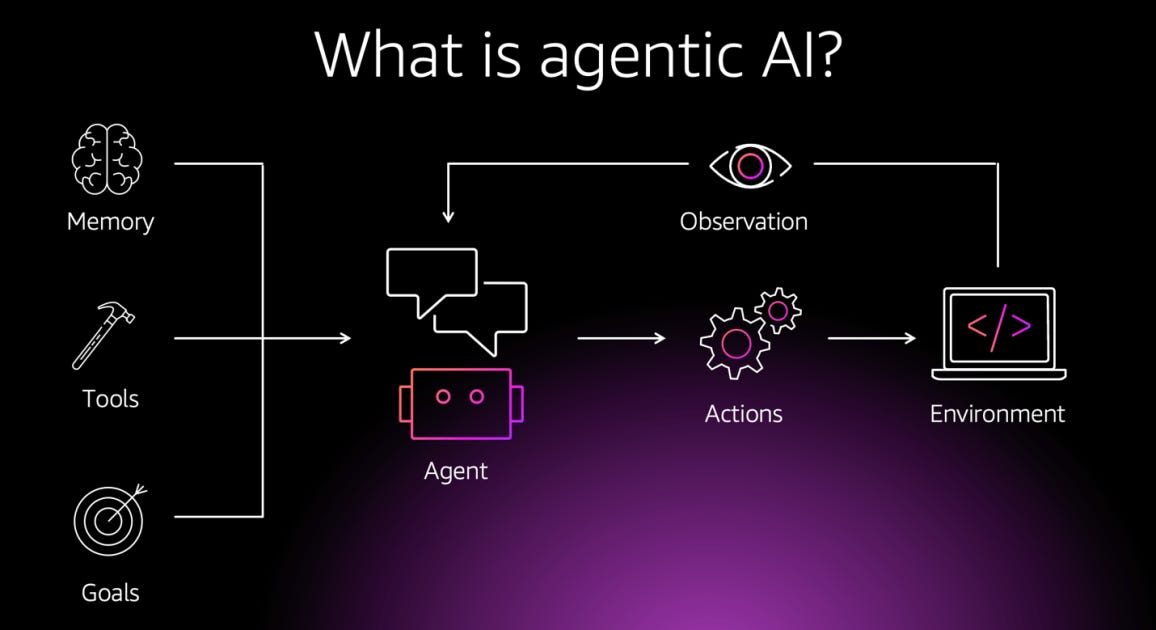
Agentic AI is a system of coordinated agents that can interpret intent, select tools, and execute workflows toward a stated outcome. Think of a distributed team:
Specialist agents handle narrow capabilities such as file search, document generation, or leave management.
Coordinator agents perform orchestration: routing, dependency management, and cross-system handoffs.
Key contrasts:
Traditional automation: brittle rules and RPA built for static processes.
Agentic AI: policy-driven autonomy with exception handling, planning, and self-monitoring across evolving systems.
2) Why Outcomes Beat Tasks
Most enterprises measure success as tickets closed or SLAs met. Agentic systems reframe success as incident prevention, cycle-time compression, and first-contact resolution across the journey. The move from task completion to outcome reliability is the core value unlock.
Practical implication: design the agent society around end-to-end journeys rather than around departmental boundaries.
3) Illustrative Deployments
HR Knowledge and Case Handling: An HR agent fields tens of thousands of queries, uses an intent classifier to route requests, calls HRIS and ITSM via APIs, drafts verification letters, and tracks approvals. Result: one interface over 20+ systems of record, with faster resolutions and fewer human touchpoints.
Sales RFP Execution: For complex RFPs, agents gather artifacts, draft proposals, and coordinate human review. Long, multi-week efforts by large teams are reduced to minutes for first drafts, with humans focusing on quality, compliance, and strategy.
Logistics Issue Resolution: Starting from Where is my order as a focused mission, agents learn carrier behaviors, query WMS/TMS, initiate reorders or refunds, and escalate to partners as needed. With journeys mapped, agents autonomously resolve the majority of eligible tickets with better speed, cost, and CSAT.
4) The Three Design Imperatives
A) Organize Around Outcomes and Name Mission Owners
Appoint mission owners for each high-stakes journey such as new-hire to first commit, RFP to submission, claim to settlement, or order to delivery.
Mission owners define goals, guardrails, and KPIs, then steer both humans and agents.
Example KPI: time to first commit for engineering hires, not number of onboarding tasks closed.
B) Unlock Silos with APIs and Shared Business Logic
You do not need a pristine single source of truth. You do need:
Resolvable semantics: stable identities, roles, entitlements, and policy dictionaries.
Operational access: read and write paths via APIs, webhooks, and connectors.
Codified business logic: definitions of what good looks like, decision thresholds, escalation paths, and exception handling in natural language plus schemas.
Start narrow to surface missing data and institutional knowledge, then generalize.
C) Govern Autonomy with Clear Guardrails
Embed policy constraints, role-based access, approval gates, and audit logs into agent behavior.
Define supervision tiers: nudge, guided mode, cooldown, or handoff to human based on risk and impact.
Maintain real-time observability with traceable plans, tool-use telemetry, and post-incident reviews.
5) Operating Model: Roles, Rituals, and Artifacts
Mission Owner: accountable for outcomes and customer experience across functions.
System Steward: owns platform integrity, governance, safety cases, and compliance.
Agent Engineers: encode policies, tools, and skills; tune retrieval and planning.
Journey Librarian: curates SOPs, schemas, and knowledge bases to keep context fresh.
Human-in-the-Loop Reviewers: perform fact checks, risk sign-off, and quality assurance.
Cadence: weekly mission reviews against KPIs, monthly safety audits, quarterly policy refresh and playbook extensions.
Artifacts to standardize:
Intent schema, tool registry, policy book, escalation matrix, evaluation suite, runbooks, and postmortem templates.
6) Data Without the Data Lake
You can start before full data consolidation if you ensure:
Stable identifiers for people, accounts, assets.
Context adapters that translate between systems.
Minimum viable semantics: glossaries for status, entitlement, priority, and SLA.
Cold paths for low-frequency lookups and hot paths for real-time actions.
Rule of thumb: invest in interoperability first, harmonization later.
7) Safety, Risk, and Compliance by Construction
Policy-first prompts: encode what is allowed, what to avoid, and what to escalate.
Tiered autonomy: routine, reversible actions can be auto-approved; high-impact actions require dual control.
Shadow mode to canary: run agents in observe-only, then recommend-only, then limited act, before full scale.
Continuous evaluation: measure hallucination rate, tool-call accuracy, escalation appropriateness, and near-miss density.
Traceability: preserve plan traces, tool inputs and outputs, and decision rationales for audits.
Closing
Agentic AI delivers when organizations reorganize. Put missions at the center, codify logic, unlock tools, and govern autonomy. Start narrow, measure hard, scale what proves reliable. The operating model is the product.
For the full details: Designing a Successful Agentic AI System